The likeness of the Garden promised to the righteous: in it are rivers of pure water, and rivers of milk forever fresh, and rivers of wine delightful to the drinkers, and rivers of strained honey. And therein they will have of every fruit, and forgiveness from their Lord. - Quran, 47. Muhammad (15)
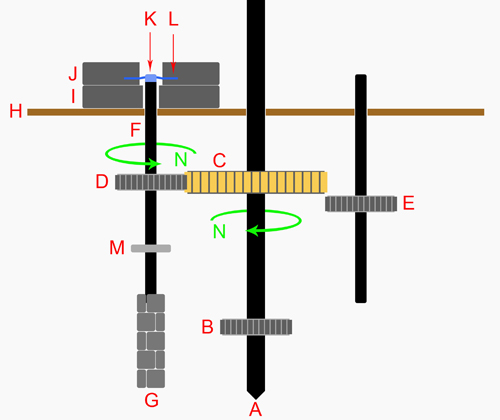
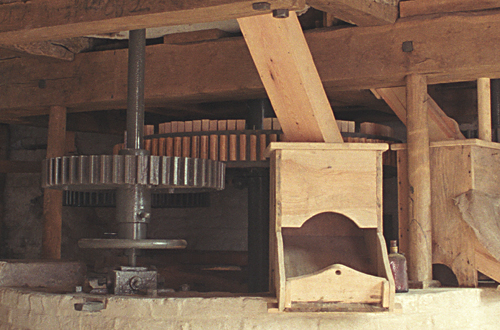
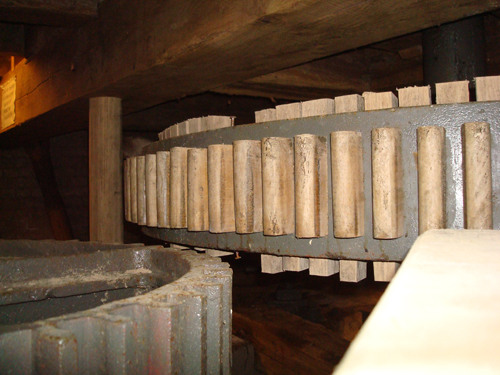
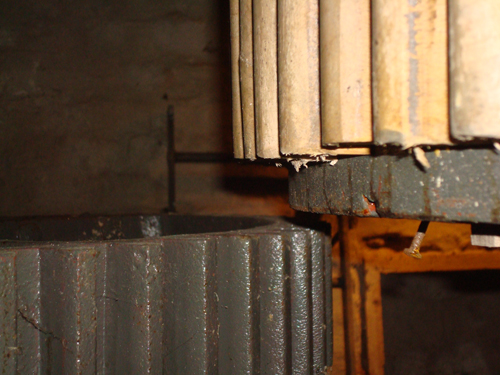
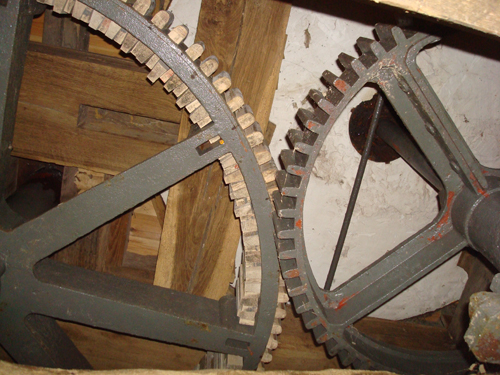
Here the vertical shaft carries a horizontal gear called the track wheel or feed wheel. It is equipped with wooden cogs and drives three spur wheels entirely made of cast iron. The spur wheels drive the millstones by means of a stone spindle.
The three spur wheels are positioned around the track wheel. The difference in diameter between the track wheel and the spur wheels will further increase the rotation speed. At Pede's Mill we find two spur wheels with a diameter of 0.72 metres, while the third one has a diameter of 0.82 metres. The greater diameter of the third spur wheel means that the transmission to the mill stones differs from the other two stone pairs. The third stone pair will have a slower speed and is reserved for a different cereal type.
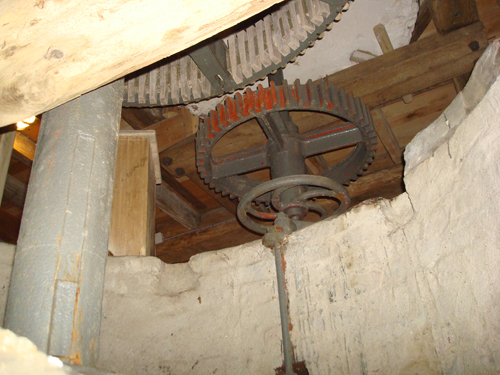
In disengaged position, the spur wheels will be situated underneath the track wheel. To engage a pair of millstones, its spur wheel is raised so that it can be driven by the track wheel. Engagement or disengagement is performed by means of a hand wheel underneath each spur wheel. Before each engagement or disengagement, the miller must of course bring the mill to a complete halt.
Two-step disposition with propulsion from underneath
This mechanism, where the transmission of hydraulic power is achieved by means of a horizontal wheel shaft, a vertical feed shaft and vertical stone spindles is called two-step disposition with propulsion from underneath. Indeed, the vertical feed shaft does not drive the millstones directly, but uses a second transmission. In this second step, the track wheel and spur wheels drive the stone spindles. The designation « propulsion from underneath » refers to the fact that all transmission elements are found underneath the millstones.
The use of spur wheels to drive two or more pairs of millstones was generalised in the 17th and 18th centuries. This was a gradual transition and most water mills in Flanders only had one pair of millstones up to about 1750. It is unclear if Pede's Mill already had three pairs of millstones when it was built in 1664 or was re-equipped at a later stage. The expansion of the mill in 1775 might point in this direction.
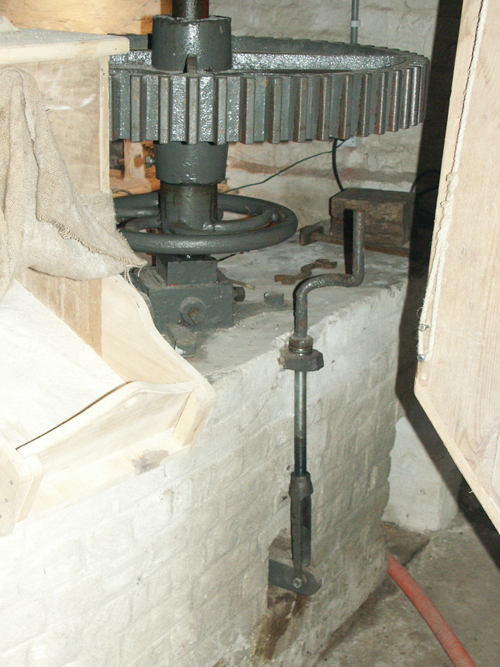
The mechanism is also provided with a system to regulate the separation of the millstones: tentering or lightering. The miller uses a handle to raise or lower the upper stone with regard to the base stone.
Where we get to the heart of the mill: the circular millstone pairs. You will also learn what feathering and dressing mean and how to take the millstone pairs apart for necessary maintenance.