The millstones
No man shall take the mill or the upper millstone to pledge; for he taketh a man's life to pledge. - Tanakh, Deuteronomy (24, 6)
No man shall take the mill or the upper millstone to pledge; for he taketh a man's life to pledge. - Tanakh, Deuteronomy (24, 6)
All the gears we have seen so far are located in the pit or on the lower floor. We now move on to the upper floor, where we find the millstones.
Pede's Mill is provided with three pairs of millstones. Each pair is formed by the union of two millstones with the same diameter. This mill is equipped with « French stones », which have the advantage of better withstanding wear and tear.
Most millstones found in Flanders originate from France. We find the designations « French » and « English » stones, but both types come from quarries in France. Stones of the first type are very porous and sharp and have a high natural cutting capacity. Stones of the second type are rather smooth.
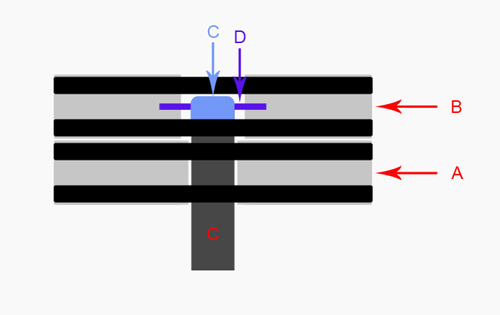
In each pair, the lower millstone is fixed and is called bed stone (alternative designations are base stone and under-runner). The upper millstone is mobile and is called runner stone (alternative designations are upper stone and over-runner).
The stones are cylinder-shaped, with a large diameter and a limited thickness. The first pair has a diameter of 1.64 metres. Here, the runner stone is 22 centimetres thick. The second pair has a smaller diameter, as it measures 1.50 metres, and the runner stone is 25 centimetres thick. The third pair has a diameter of 1.64 metres and the thickness of the runner stone is 35 centimetres.
The runner stone is driven by the stone spindle, which passes through the bed stone. The stone spindle is linked to the runner stone by means of a clutch and a rynd. The clutch is fixed on the stone spindle and grabs the rynd in its centre. The rynd is a metal bar in an X shape that is sealed in the runner stone. This type of rynd is called cross rynd or Flemish rynd and is the type most often used in this part of Belgium. The stone spindle, the clutch and the rynd will transmit the circular movement to the runner stone.

Millstones are usually assembled from different parts, rather than cut out of one piece. Each millstone in Pede's Mill consists of various concentric parts and is formed by the assembly of rocks of different size and hardness. From the inside towards the outside, we first have the waist, pierced with an orifice in its centre, the eye. In a figurative sense, we could say that it is through this part that the millstones « swallow » the grain.
The waist is generally made out of one piece: it must be sufficiently solid, as it is the point where the rynd is fixed and on which the runner stone is suspended with its full weight. The waist is surrounded by a part called the frame. It consists of two parts, the breast (also called the reducing zone) and the grinding zone.
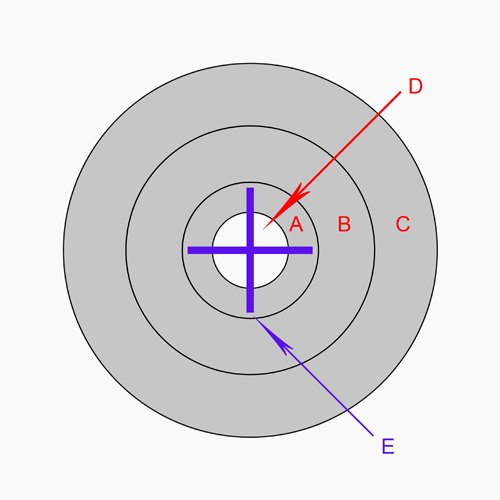
The frame is constructed of several hard and irregular stones. The most resistant stones are reserved for the grinding zone on the outside. Each part of the millstone must be constructed of stones with identical hardness and presenting the same furrows, which give the millstone its abrasive quality.
Each millstone is surrounded by two iron rings. The iron rings are applied when hot and will tightly hold the assembled millstone in place when they cool down and contract.
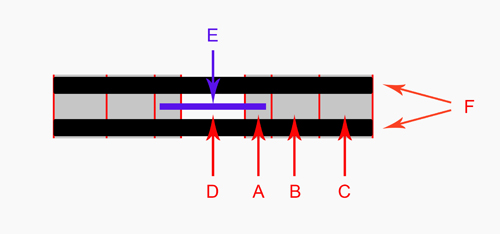
On the other side of the working surface, the back of the millstone is filled with small rocks embedded into thin concrete, so as to give the millstone its necessary weight and thickness. If necessary, cast iron pieces can be inserted in the concrete in order to balance the millstone. In order to obtain the finest possible flour, the distance between both millstones must be as shallow as possible, but at the same time any direct friction between them must be avoided. First the bed stone is secured with great accuracy by means of wooden pikes.
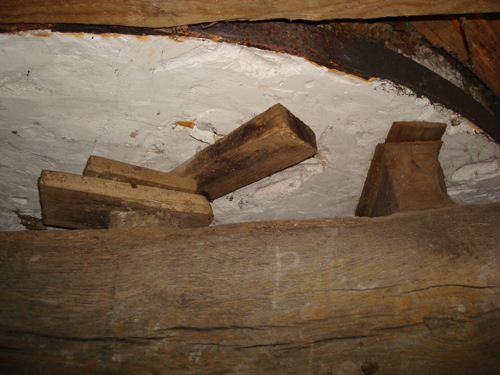
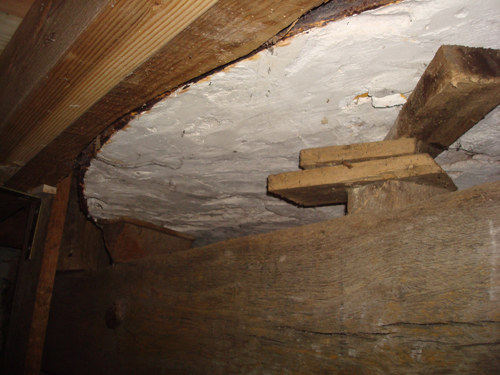
A perfect parallelism between both stones is obtained by balancing the runner stone, so that it will turn without jolts or vibrations in the same plane as the bed stone. The distance between the millstones is so shallow that it is not recommended to let them turn without flour. This could cause sparks between the two stones, which needs to be avoided at all cost in a building mostly constructed of wood.
Wheat is introduced into the eye and finds its way between the two millstones. The surface of the bed stone is completely horizontal, but the runner stone has some room, the entry, in its central part. At this precise spot, the runner stone has been cut out slightly, so that grain can be introduced between the stones.
Both millstones will grind the wheat until it is reduced to flour. As grinding takes place and the wheat diminishes in volume on its way towards the rim, the space between the millstones gradually decreases.
The major difficulty one has to overcome is to avoid increasing the temperature of the flour due to the pressure of the millstones. The internal surface of the millstones is provided with grooves which are called furrows. The furrows are not directed according to the geometrical radius of the millstone, but are leaning either towards the right or towards the left.
The two millstones of a pair have furrows that run in the same direction. Reversed on top of each other, their furrows will be inverted and will cross each other in a movement similar to that of a pair of scissors. Towards the outside, the crossing angle of both millstones is reduced. In theory, this would reduce the cutting ability, but this is compensated by the higher rotation speed of the millstone towards the rim. The furrows participate in the ventilation of the space between the millstones and also help to evacuate the flour towards the rim. The millstones function according to the principle of cutting, milling and evacuating the flour.
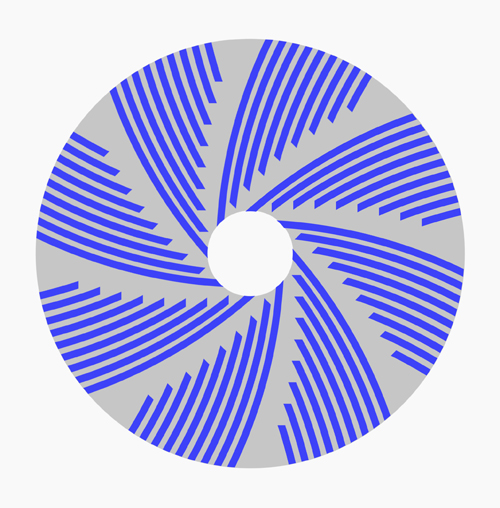
Due to the centrifugal force, developed by the rotation speed, wheat passes between the millstones fairly quickly. The furrows on the surface of the stones guide the wheat and ease its progression. At the rim, between the furrows, the millstones are covered with fine grooves which are carved in the stone. The characteristic of carving grooves into the millstones is referred to as feathering and increase the cutting power of the stones, so that grinding wheat will be more effective.
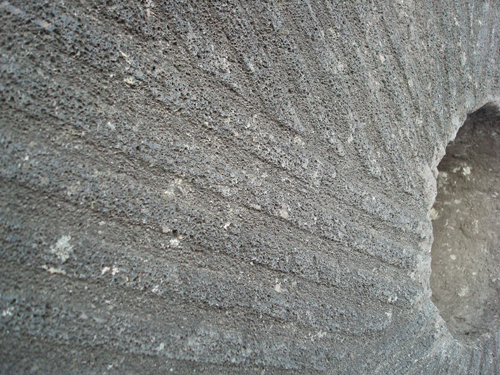
Although we have three pairs of millstones at Pede's Mill, these cannot function all at once, due to the relatively limited flow rate of the brook and the resulting motor torque. The millstones need a periodic rest and the miller will use them alternatively. Feathering of the millstones must be done at regular intervals: the runner stone is lifted up and turned over to expose its furrows. The furrows of the runner stone and the bed stone are then adjusted with a dressing pick.
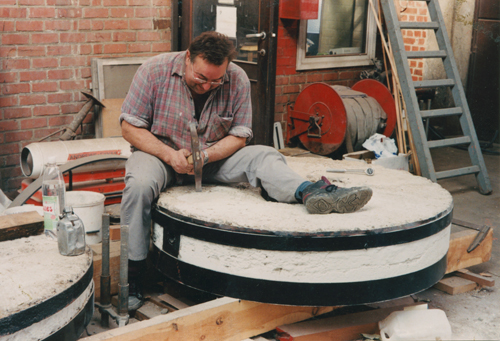
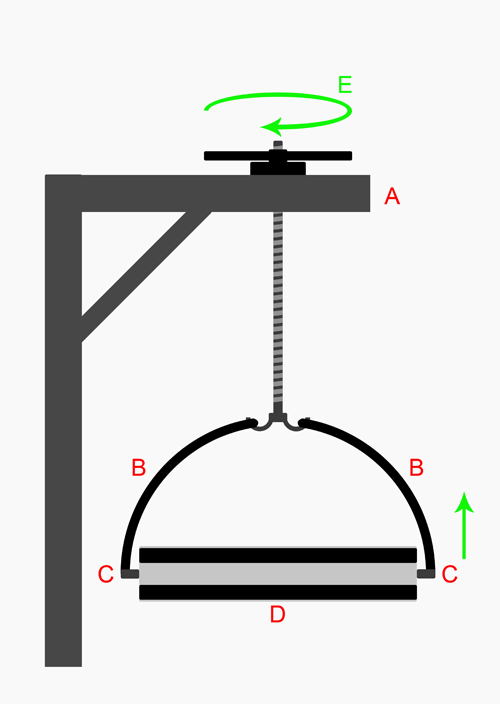
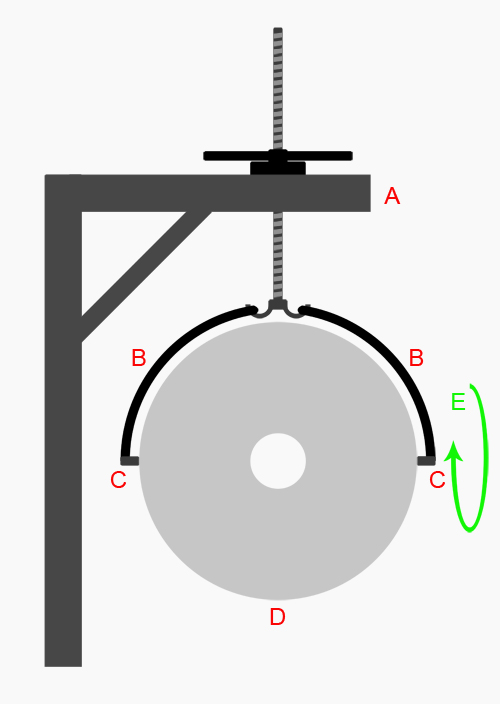
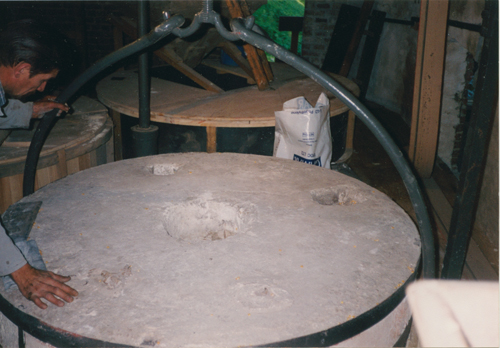
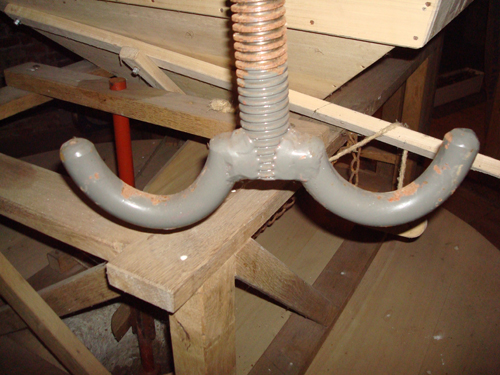
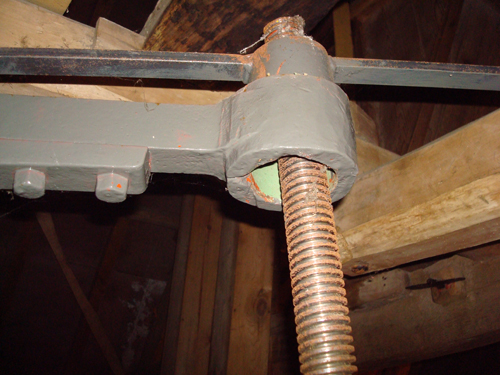
The uncovering of the pair is done with the strut or stone crane. This device is firmly attached to the floor and to a transversal beam anchored in the walls. The stone crane can be moved relative to the millstone that needs to be turned over. Iron arches are attached to each side of the runner stone and firmly fixed with iron pins. The arches are connected to a large adjusting spindle: turning the spindle lifts the runner stone at the hoist of the stone crane. When the runner stone has been lifted sufficiently, the stone crane is pivoted on its axis, the stone turned over to expose its furrows and laid on the floor next to the bed stone.
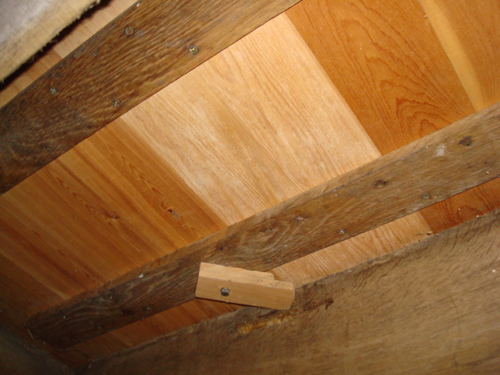
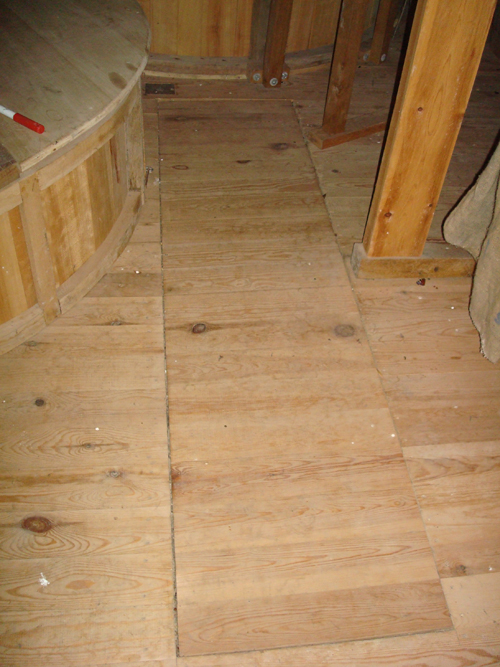
There is also a trapdoor between both floors to remove worn down millstones and replace them with new ones. This trapdoor measures 210 by 50 centimetres.
Where we will see how all the machines on the upper floor are operated by means of pulleys of different sizes.