With Him are the keys of the unseen. None knows them except He. And He knows everything on land and in the sea. Not a leaf falls without His knowledge, nor is there a grain in the darkness of the earth, nor is there anything wet or dry, but it is in a clear record. - Quran, 6. Livestock (al-An'am) (59)
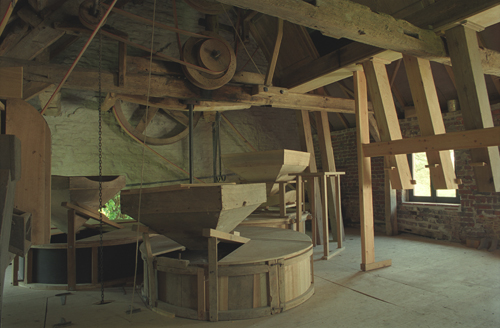
The vertical shaft (feed shaft) that carries the lantern gearing and the track wheel extends through the floor of the millstone attic. At its end, we find an angle gear which transmits the vertical circular movement towards a horizontal shaft under the roof. This shaft is equipped with pulleys, which will operate all the machines on the upper floor.
Pulleys are used to transmit the movement and motor torque from one shaft to another by means of a belt. The pulleys allow a factor of multiplication or division of the rotation speed. Consequently, they have different diameters and are calculated to operate each machine at a specific speed. Amongst the machines in the millstone attic, the highest speed corresponds to the milling separator, while the slower speeds correspond to the boulter, the flour elevator and the sack hoist (see the following chapters for a description of these machines).
In old water mills, as here in Pede's Mill, we often find wooden pulleys. This type of pulleys is considerably lighter than cast iron pulleys and give a better grip for the leather belts.
The need to operate certain machines intermittently entails the use of fixed and loose pulleys. To stop a machine, one needs to transfer the belt onto the loose pulley, which turns freely on the axle without driving it. To engage a machine, one needs to transfer the belt from the loose pulley onto the fixed pulley. A wooden bar is used to transfer the belt from one pulley to the other.
The next chapter at a glance:
Where we will see how the belts connect the different pulleys. You will also learn the difference between straight and crossed belts.