If a man cause a field or vineyard to be eaten, and shall let his beast loose, and it feed in another man's field; of the best of his own field, and of the best of his own vineyard, shall he make restitution. If fire break out, and catch in thorns, so that the shocks of corn, or the standing corn, or the field are consumed; he that kindled the fire shall surely make restitution. - Tanakh, Exodus (22, 4-5)
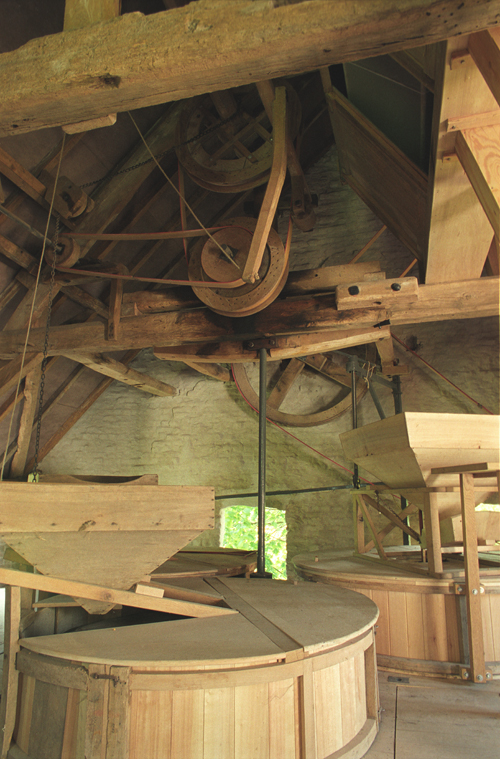
The belts transmit the torque from one shaft to another, provided that these shafts are not too far apart and that the torque is of an appropriate intensity.
The belts are said to be straight, crossed and sometimes even semi-crossed. When the shafts are parallel and the pulleys in the same line, straight belts are used to make the pulleys turn in the same direction. When the belts are crossed, the pulleys will turn in opposite directions. When the shafts that need to be connected have angular positions, we will need to use semi-crossed belts.
The belts in Pede's Mill are cut out of leather. This material has the advantage of being strong, flexible and elastic, but it is also very sensitive to changes in temperature and humidity. This implies that the belts need regular maintenance and special attention. Transmissions by leather belts are simple, relatively quiet and absorb vibrations. Moreover, they work well at high speeds and with considerable motor torques.
As all machinery on the upper floor is operated by means of belts, one has to be extremely careful when working in the mill. Even if certain pulleys and belts turn relatively slowly, the entire set of different belts turning at the same time present a continuous hazard. Also the turning of shafts, cog wheels and angle gears on the lower floor can entail dangerous situations. This is why during maintenance work, one has to be absolutely sure of the complete halt of the mill and the impossibility of a sudden restart.
The next chapter at a glance:
Where you will learn about four additional machines that are essential to the milling process and how the relative speeds are controlled.