And he spake many things unto them in parables, saying, Behold, a sower went forth to sow; and when he sowed, some seeds fell by the wayside, and the fowls came and devoured them up: some fell upon stony places, where they had not much earth: and forthwith they sprung up, because they had no deepness of earth: and when the sun was up, they were scorched; and because they had no root, they withered away. And some fell among thorns; and the thorns sprung up, and choked them: but other fell into good ground, and brought forth fruit, some a hundredfold, some sixtyfold, some thirtyfold. Who hath ears to hear, let him hear. - Bible, Matthew 13 (3-9)
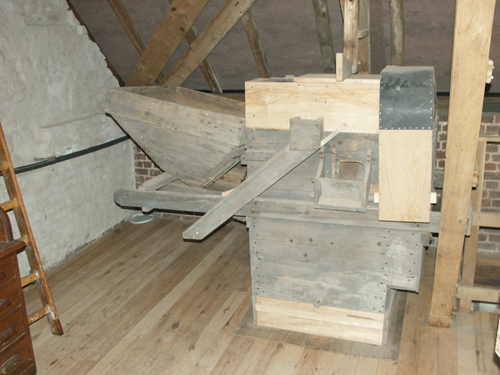
When wheat arrives at the mill, it may contain small bits of straw, small rocks, dust or other impurities. Before it can be ground, the wheat needs to be cleaned in order to remove all impurities.
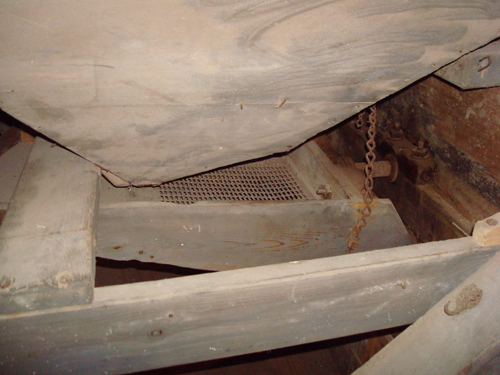
As a first step, the wheat is sorted by several sieves. The first sieve eliminates impurities that are larger than the wheat grains. With the passage through a second sieve, parts that are smaller than the wheat are rejected. The second sieve will also remove wheat of a very small size, which only contain a very small amount of flour.
When this first sorting has been carried out, the wheat passes through a conduct, where it will be submitted it to an air draught produced by a ventilator. Thus all particles lighter than the wheat, such as small bits of straw, will be expelled.
The ventilator of the milling separator works at a relatively high speed, with an adequate transmission by pulleys. Here a large conductive pulley is used on the transmission shaft and a small pulley to drive the ventilator.
As a second step, the wheat will be submitted to a more intensive cleaning. It will pass through a drum, covered with small metal spikes in which the grain will turn at high speed. The blades will move the wheat around and rub it against the inner walls of the drum. The surface of the wheat will be literally sanded.
The drum of the milling separator works at a slower speed than the ventilator, but must be sufficiently vigorous to provide proper cleaning. Again, the pulleys are adapted to the specific function of the milling separator.
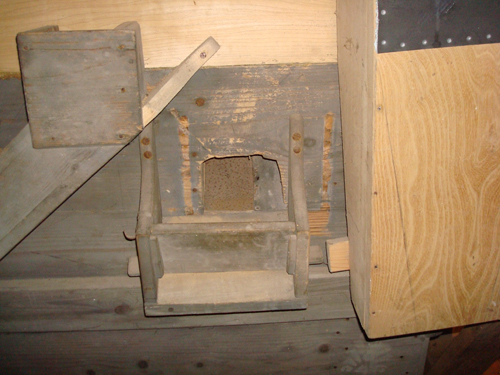
When the wheat leaves the drum, it is again submitted to an air draught, which will eliminate dust produced by the sanding. The clean wheat is then collected to the side of the machine and put in bags, ready to be ground.
The next chapter at a glance:
Where we see how wheat is converted to flour. We will also learn how to regulate the fineness of the proces and choose our final product.