Milling of wheat
It is God Who splits the grain and the seed. He brings the living from the dead, and He brings the dead from the living. Such is God. So how could you deviate? - Quran, 6. Livestock (al-An'am) (95)
It is God Who splits the grain and the seed. He brings the living from the dead, and He brings the dead from the living. Such is God. So how could you deviate? - Quran, 6. Livestock (al-An'am) (95)
The millstones are locked in a wooden casing, designated by the terms stone cover or stone furniture. On top of this casing we find the funnel-shaped hopper, designed to receive the wheat to be milled. Below the hopper we find a wooden recipient: the shoe, also called slipper or feed shoe. Under the shoe we find the agitator, also called rattler or damsel, which is connected to the stone spindle.
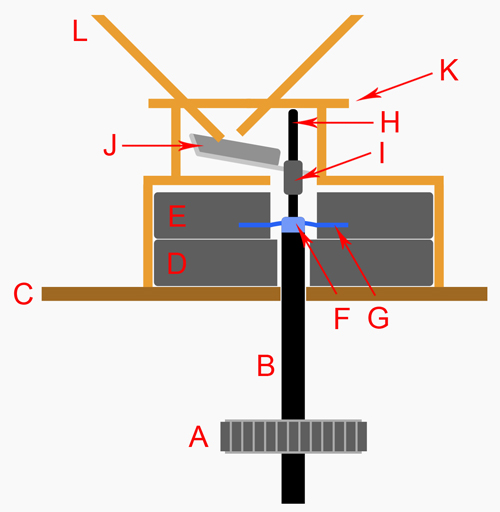
To start milling, wheat is poured into the hopper. The opening at the bottom can be regulated by means of an adjustable latch. The stone spindle, which moves the upper stone, also drives the agitator. This element will stir the feed shoe at regular intervals: this way the wheat falls into the eye (opening in the upper millstone) and distributes itself evenly between the millstones. The agitator functions like a vibrator and regulates the feeding of the millstone pair completely automatically. The feed shoe is suspended on a string, which serves to regulate its inclination and modify the amount of wheat. The feed shoe and agitator produce a characteristic tic tac sound, so that an experienced miller can determine the correct rotation speed of the millstones by ear.
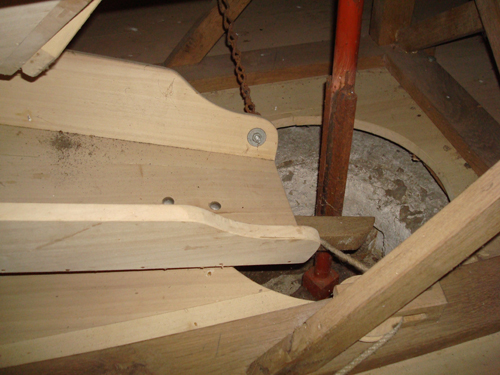
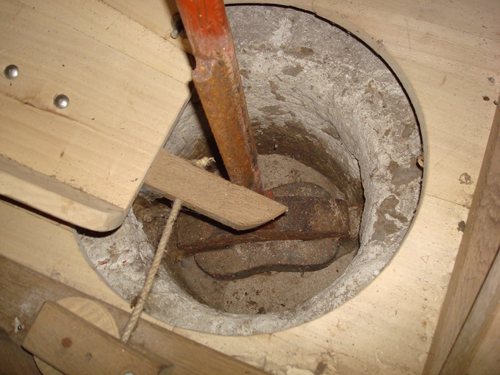
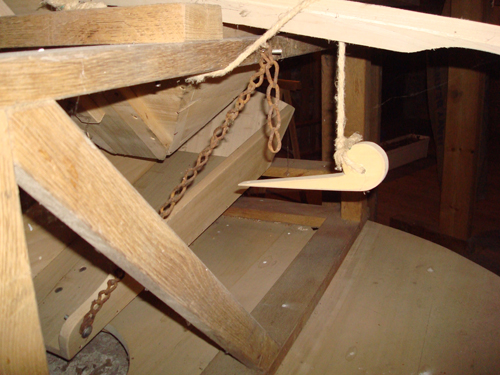
The wheat passes between the two millstones and is progressively reduced to flour. It is evacuated at the side of the millstones. Between the casing and the bed stone there is a gap of approximately 5 centimetres: the ring. The flour is collected underneath the stones by a wooden pipe called spout. It passes through the floor and leads to the lower floor. The spout is placed almost vertically, with a slight inclination, and transports the flour by the sole force of gravity, without the risk of obstructions.
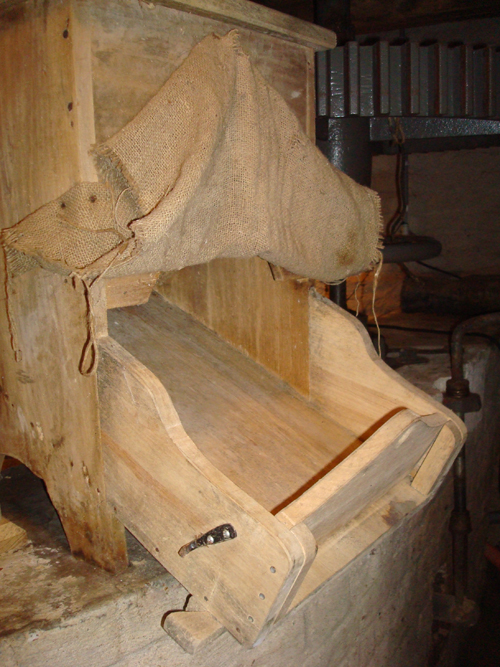
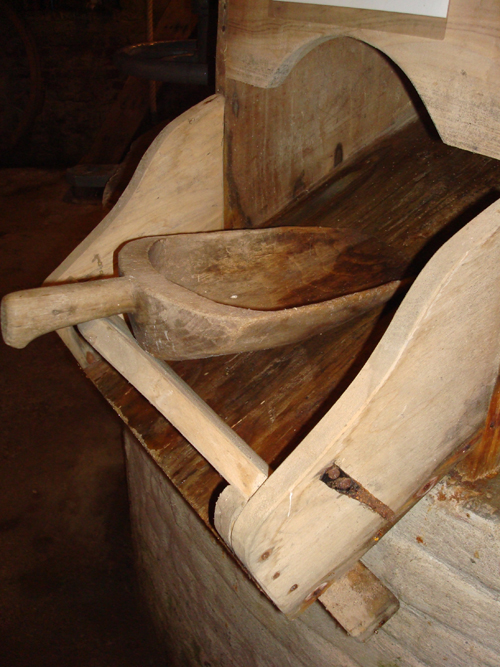
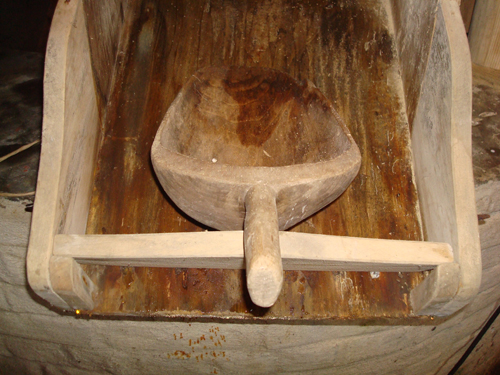
At the end of the spout we find the flour receptacle, where the flour is collected in bags. The slanted base of the flour receptacle is made of walnut wood: this type of wood allows an optimal sliding of flour. When the bag is full and needs to be replaced by another one, the flour receptacle is temporarily closed with a wooden latch. In order to avoid the scattering of dust, a piece of cloth is placed over the flour receptacle during the milling process.
The fineness of the flour can be regulated by modifying the space between the millstone pair by means of the tentering (see previous chapters). This needs to be adjusted at regular intervals and can vary according to temperature, air humidity, humidity of the wheat and also the variety of wheat. Good regulation of the milstones requires certain experience, as the fineness of the flour is judged at the sense of touch.

The following illustration represents the complete milling installation, from the water wheel to the hurst.
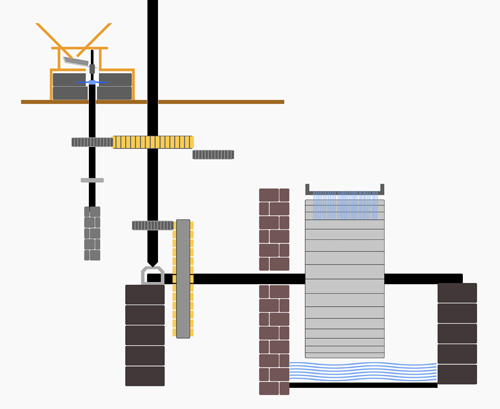
Where we will have a look at the flour elevator, which will transport our final product back to the upper floor.