And the meal-offering thereof shall be two tenth parts of an ephah of fine flour mingled with oil, an offering made by fire unto the LORD for a sweet savour; and the drink-offering thereof shall be of wine, the fourth part of a hin. And ye shall eat neither bread, nor parched corn, nor fresh ears, until this selfsame day, until ye have brought the offering of your God; it is a statute for ever throughout your generations in all your dwellings. - Tanakh, Leviticus (23, 13-14)
Milling produces integral flour, which contains all the grain's elements: coatings, germ and starch. It can be used as such to produce wholebread. The wheat's coatings will give the dough its colour and produce wholebread.
To produce white bread and for use in fine pastry, flour needs to be cleared of these coatings, to retain only the starch particles. The wheat's coatings, also called bran, are the coarsest particles of the integral flour, while the starch particles constitute the finest part. The boulter will therefore separate the bran from the starch.
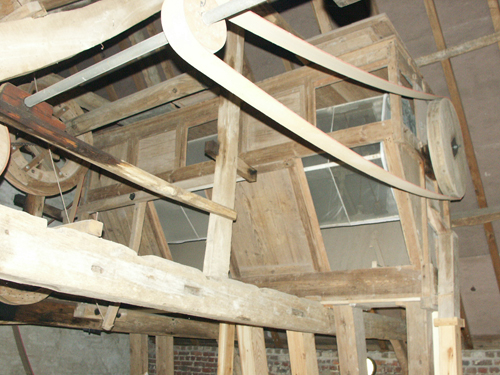
The boulter is a long wooden case, inside of which a cylinder with a hexagonal base turns on an inclined axis. The cylinder is covered with a sieve in various sections of decreasing fineness: the finest sieves are situated at the beginning and the coarsest sieves at the end. The difference in mesh opening determines the fineness of the flour.
The integral flour is poured into the sieve at the entry of the boulter. Due to the centrifugal force of the rotation and the agitation of its rotating blades, the boulter will push the flour towards the exit. It first eliminates the finest particles at the beginning and then the coarsest particles at the end. The particles that do not pass through the coarsest sieve are evacuated to the side of the boulter: this is bran, i.e. the coatings that were torn during the milling process. Bran can be used to feed animals.
To insure a correct separation of flour and bran, the internal mechanism of the boulter needs to turn relatively slowly. This is why the transmission pulley coupled to the boulter is very large compared to the pulley that is driven by the water wheel. Transmission from a small pulley to a large pulley slows down the rotary motion.
The boulter seperates integral flour into three product types: white flour, which corresponds to the finest particles, bran, which corresponds to the coarsest particles, and an intermediate product called feed meal.
The amount of bran removed by the boulter will always be approximately 18% of the total weight of the integral flour. The remaining 82% is shared between white flour and feed meal.
At the lower part of the boulter, a system of screws and trap doors allows the evacuation of flour. By opening or closing one trap door instead of another, the miller chooses to produce finer or coarser flour.
A good regulation of the millstones is essential to obtaining a correct flour bolting. During the milling process, one must avoid to break the coatings too much, while at the same time the starch needs to be ground as finely as possible. This explains the importance of correct maintenance of the millstones: dressing at regular intervals, a correct spacing between the millstones and an appropriate rotation speed.
The next chapter at a glance:
Where we will have a closer look at the oats crusher, once an essential machine to feed the horses which were formerly employed to work on the fields.