Who hath measured the waters in the hollow of his hand, And meted out heaven with the span, And comprehended the dust of the earth in a measure, And weighed the mountains in scales, And the hills in a balance? - Tanakh, Isaiah (40, 12)
The region of Zwalm has an ideal biotope for the construction of water mills: a profusion of small brooks with plenty of water, a countryside with the necessary slopes to take advantage of the energy of a natural or artificially created waterfall, a productive region with a dense population, a well structured agriculture and an age-old small scale trading culture, a favourable climate with regular rainfall and a soil extremely well suited for cereal crops.
The first water mills in the southern part of East Flanders are already mentioned in the 9th century. The oldest water mill in the area is the Perlinck Mill of Elst, which is part of the town of Brakel, situated on the border between the Zwalm region and the « Vlaamse Ardennen » (Flemish Ardennes). This water mill is already mentioned in 868. Water mills were the first mechanical workshops along the brooks and small rivers. Later, at the end of the 12th century, we find the first mentions of windmills, which were constructed on hill tops, where the woods had given way to fields.
Flandria terra molinenda est
« Flandria terra molinenda est »: Flanders is the land of the mills. Already in the 15th and 16th century, Flemish mills were very well known outside its borders for their innovation and technical solutions. Indeed, most of the perfections carried out to mills originated in the old County of Flanders. During the Middle Ages, this was the most populated territory in Western Europe. After Paris, Ghent was the most populated town. The innumerable water and windmills gave Flanders a privileged position on the international scene.
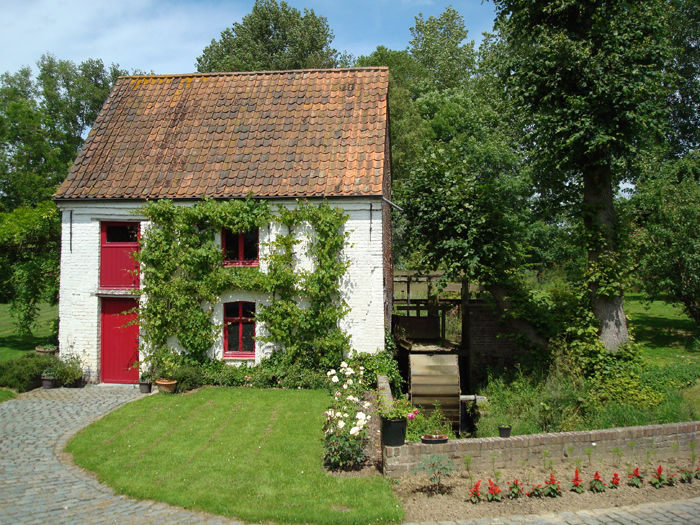
Until the beginning of the 19th century, windmills and water mills were practically the only source of energy. They served not only to grind wheat or chicory, but also to extract oil, to shell cereals, to hull rice, to manufacture paper, etc. Pede's Mill mainly served to grind wheat, but it was also employed to crush oats.
Bread used to be a very important product and one of the fundamental food elements. Consequently, mills were indispensable to provide flour to the population and had a prominent role in the local economy. They formed an important link between the farmers and the population. Moreover, a number of artisan activities depended directly from these mills, as they were involved in their building and maintenance. The dressing of the millstones was often performed by specialised workmen, who visited each mill in turn to perform this task.
Illustration #8-1 (Wikimedia)
It is clear that millers were prosperous citizens, who provided an essential contribution to the village or town and who enjoyed a good social position. Proof of this can clearly be seen in Pede's Mill, where the mill building has been separated from the house and the stables, which meant a considerable investment. Often, the profession was handed over from father to son. It was quite common that the miller's daughters married a miller, so that the profession, acquired skills and accompanying mills stayed in the same family. Know how and professional secrets passed from father to son.
In the 18th and 19th centuries, windmills and water mills formed a genuine network of small workshops. These two centuries can be considered as the peak of the industries related to wind and water energy. The expansion of the railway network to all parts of the country and the generalisation of electricity at the beginning of the 20th century turned local economic life upside down. The social structure of the preceding centuries changed considerably. Rural society up till the 19th century was largely self sufficient and had little contact with other villages or towns. Around 1830, the industrial revolution would change this profoundly. The gradual opening towards the exterior meant that these small mills had a hard time to compete with newer and bigger production plants. Around 1880, a number of water mills were equipped with steam power, in an effort to stay competitive in the changing times. But traditional mills gradually lost their economic importance and were relegated to a side track of technical evolution.
Rural exodus had already started much earlier, but the second wave at the beginning of the 20th century meant the demise of traditional mills and the reorientation of the specialised workmen who either worked at the mills or were involved in their construction or maintenance. Shortly after World War II, most Flemish water and windmills stopped production, as small scale milling industry was void of any significant economic value. Some smaller mills continued to produce flour on a very small scale, mostly limited to private use only, as even the local farmers and bakers stopped demand. Finally, a large number of these small production units disappeared between 1950 and 1960, as they were gradually abandoned or in some cases completely dismantled and pulled down.
Although the profession of miller hardly exists today, many traces have remained in the current language. We can mention the numerous family names which stem from « mill » or « miller ». In the Dutch speaking part of Belgium and in the Netherlands, we find amongst others the family names De Mulder, De Meulemeester, De Meulenaere, Vandermeule and Molenaers (miller's son or daughter). In the French speaking part of Belgium and in France we find amongst others the family names Miller, Lemeunier and Dumoulin.
Also numerous local sayings refer to a rich mill history: « He who comes first, mills first », « No mill functions with past water » (= past actions cannot be changed) and « When the mouse is in the flour sack, it thinks it is the miller » (= a sarcastic conception of arrogant people).
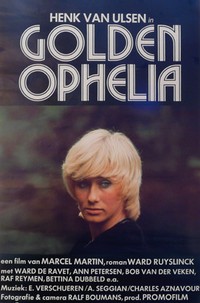
The water mill and its surroundings were selected in 1974 as the setting for the movie « Golden Ophelia », based on the book with the same title by Ward Ruyslinck. Marcel Martin was the director.
Picture #8-2: Poster of the movie « Golden Ophelia »Picture #8-3: Scene from the movie « Golden Ophelia »
The next chapter at a glance:
Where we will see how the driving force of the water is transformed into a circular movement and multiplied by a transmission mechanism, consisting of gears, pulleys and belts.